Tuesday, 29 March 2011

Why western countries are using double standards ?

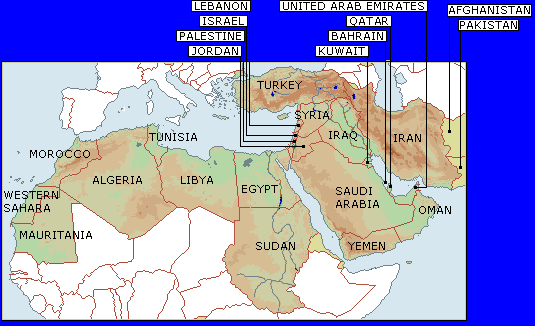
After the Islamic revolution in Iran in 1979, the West nervously waited for similar uprisings in the "Arab Street." Practically nothing changed in the Arab world in the last 30 years. In 2011regimes in Tunisia and Egypt have been overthrown by the peoples' demonstrations; the uprising in Libya has forced the international community to take military action against  Gadhafi; Yemen is witnessing bloody chaos; Syria is showing signs of serious unrest and Saudi Arabia intervened in Bahrain to crush the opposition.


         So far, none of the peoples' movements have been directed against the West. It was not "Western imperialism" but a combination of domestic political repression, youth unemployment, heightened expectations and socio-economic deprivation that mobilized Arab masses.Unfortunately, this positive dynamic may soon come to an end.In the eyes of many Arabs in the region, a deeply troubling Western double standard is emerging. Why is the West willing to intervene in Libya, while there is total Western silence about the brutal suppression of dissidents in Bahrain?
The West appears to be quite selective in lending its support to the "Arab Spring." The lesson that many are drawing is that two distinct standards apply to Arab citizens' rights. In countries like Libya, Egypt and Tunisia, the world will accept or actively support constitutional changes that citizens of those countries demand. In other Arab countries, like Bahrain, the rights of citizens are secondary to wider energy and security needs."
The fact that Saudi Arabia and the United Arab Emirates sent troops to Bahrain clearly shows that these energy-producing conservative Arab countries are deeply worried about a spillover of unrest into their own countries.
But such Western security concerns don't change the question that millions of Arab youth are asking: Why should the U.N. principle of "responsibility to protect" apply only to countries like Libya and leave Bahrain and Yemen out in the cold? Surely all regimes in the region are not equally brutal. Bahrain, Saudi Arabia or Yemen may appear to have more legitimacy than Gadhafi's regime in Libya, yet the Yemeni and Bahraini governments have shown no mercy against protesters. The double standard is also obvious in the Saudi behavior. The Saudis have backed intervention in Libya to help the rebels at the same moment as they have sent troops into Bahrain to help suppress a rebellion.

Unless Europe and the United States become more consistent in their support for democracy in the region, soon it will be radical Islamists and enemies of the West that will have the upper hand in mass demonstrations. But in the case of India, as we can expect India will shy away from taking position either side. At the end of the day India is never been in this process & it never will !!

Thursday, 17 March 2011

Evaluation of Rupee from 1950's to 2011

Through out the history of Independent India, Curren Since 1950's , India ran continued trade deficits that increased in magnitude in the 1960s. Furthermore, the Government of India had a budget deficit problem and could not borrow money from abroad or from the private corporate sector, due to that sector’s negative savings rate. As a result, the government issued bonds to the RBI, which increased the money supply, leading to inflation. In 1966, foreign aid, which was hitherto a key factor in preventing devaluation of the rupee was finally cut off and India was told it had to liberalise its restrictions on trade before foreign aid would again materialise. The response was the politically unpopular step of devaluation accompanied by liberalisation. Furthermore, The Indo-Pakistani War of 1965 led the US and other countries friendly towards Pakistan to withdraw foreign aid to India, which further necessitated devaluation. Defence spending in 1965/1966 was 24.06% of total expenditure, the highest it has been in the period from 1965 to 1989 . The second factor is the drought of 1965/1966. The sharp rise in prices in this period, which led to devaluation, was often blamed on the drought by government.
At the end of 1969, the Indian Rupee was trading at around 13 British Pence. A decade later, by 1979, it was trading at around 6 British Pence. Finally by the end of 1989, the Indian Rupee had plunged to an all-time low of 3 British Pence. This triggered the onset of a wave of irreversible liberalisation reforms away from populist measures.

1991 Economic crisis

In 1991, India still had a fixed exchange rate system, where the rupee was pegged to the value of a basket of currencies of major trading partners. India started having balance of payments problems since 1985, and by the end of 1990, it found itself in serious economic trouble. The government was close to default and its foreign exchange reserves had dried up to the point that India could barely finance three weeks’ worth of imports. As in 1966, India faced high inflation and large government budget deficits. This led the government to devalue the rupee.
At the end of 1999, the Indian Rupee was devalued considerably.

 Revaluation

In the period 2000–2007, the Rupee stopped declining and stabilized ranging between 1 USD = INR 44–48. In recent times, the Indian Rupee had begun to gain value and by 2007 traded around 39 Rs to 1 US dollar , on sustained foreign investment flows into the country. This posed problems for major exporters and BPO firms located in the country. The trend has reversed lately with the 2008 world financial crisis. The changes in the relative value of the rupee has reflected that of most currencies, e.g. the British Pound, which had gained value against the dollar and then has lost value again with the recession of 2008.

Valuation history


Tuesday, 22 February 2011

Things to remember before intraday trading

  • If index is in positive from yesterday and the share you are holding is in minus then it should be cut and if intraday trend of index is in buy then one should buy a stock in which is in plus.
  • If index is in minus then one should look to short stocks which are minus and not stocks which are in plus.
  • It is not necessary that a stock which is weak today during intraday trading might be weak tomorrow also, simultaneously if a stock is strong today might not be strong tomorrow
  • If US Markets have gone up overnight, the markets here in all probability will open strong, so one should be quite careful when buying stocks as the general psychology of public is to buy when good news is there.
  • Being a contrarians is very important while trading intraday.
  • Stop loss is a must while trading intraday.
  • Always trade in very liquid stocks i.e. which have very high volume because as entry and exit can be very fast in such stocks.
  • Do paper trading before you actually start trading so that when you start making paper profits, then shift to actual trading.
  • Keep your volume constant e.g.: if you trade in five lots of nifty future then trade in five lots only. This position can be increased only when you are satisfied with your trading for a month. It should not be that one day you buy five lots and next day you trade in ten lots and third day you get a loss and stop trading for two days.
  • Fear and Greed are at maximum levels while trading intraday so always have less position when you are new to intraday trading as otherwise you will be mostly under tension.

Thursday, 13 January 2011

Sagarika Ghose, Arunadhti Roy, MF Hussain & tweeples


                 The above tweet shows her intellectualism and apparently her arrogance is well documented.. Her writings in Hindustan times are merely choppy rhetoric. How a person can be " liberal" when he/she is crawling in the feet of minorities and at the same time barking at majority, day in day out. Her support for Arunadhti Roy & MF Husain is familiar for most information seekers... But every unbiased educated Indians knew who they are!!!

Arunadhti Roy is a dishonest hypocrite who most shamelessly applies double standards- she justifies killing of 72 CRPF jawans at the hands of Maoists and calls a religious frenzy in Kashmir a freedom struggle knowing fully well that they are responsible for ethnic cleansing in the valley throwing tens of thousands of Kashmiri Pandits out of their homes. Arundhati Roy is a typical example of such parasitical elements within India who benefit from its generosity while stabbing thier motherland in the back... Just winning a prize doesn't make her an intellectual.I dont accept a single word coming out of her mouth and i am dying to see her rotting in a jail for life.I dont care if she gets noble peace prize.

Nobody needs intro for MF Hussain:
 If MF Hussain is a liberal then the cartoonist of Muhammad is the greatest liberal. How can painting n*de pictures of hindu g0ddesses be part of anyone's freedom ? Will MF Hussain paint n*de pic of his Pr0phet ? Isn't it a deliberate provocation ? Still no one tried to kill him and the over clever mullah chose to run away. These are the pseudo intellectuals are deliberately stepping on their nerves to provoke anger as the only thing these Indian joker intellectuals understand from west is that they have to make some people angry.. very angry ..than they will become intellectual.. By going through this one can understand why tweeples are angry over Sagarika Ghose & her pseudo secular views..

India is the only country where people who mock its culture and religion are called 'intellectuals' and 'liberals' and given special status...

Note: The content in this post are purely personal .

Wednesday, 5 January 2011

how to pick the right stock in Jhunjhunwala's way

If you’re a proponent of value investing, which involves buying stocks that offer value when they’re cheap and holding on to them till they achieve their potential — Warren Buffet style — here are tips from India’s own Buffet, Rakesh Jhunjhunwala, that you may use.
— Jhunjhunwala’s advice to investors is not to look for companies that would give profits but understand factors that help in creating profits. “Don’t emphasise too much on analysis of profits,” he says. “Profits are created due to various stages of circumstances. I always look at how large is the opportunity for that business in the sector.”
He recalls how he bought Praj Industries, a bio-ethanol company that gave him large returns. “When I bought Praj, we thought there would be a humongous demand for ethanol. The opportunity was huge but it was not recognized.”
IT bellwether Infosys, he said, benefited because of the internet revolution. “Nobody knew about Infosys in 1993 but Infosys could become Infosys because the opportunity for the internet went through the roof.”
“When opportunities come, they can come through technology, marketing, brands, value protections, capital, etc. You need to be able to spot those.”
— “Then I look at scalability of a particular company that I choose in a sector,” Jhunjhunwala says. “A friend of mine asked me: should I invest in a small cap or largecap? I said we must invest in the smallcaps, which will be the largecaps. The biggest challenge of investing is that you should recognise whether organization has the ability to scale.”
Jhunjhunwala says he makes an investing decision by understanding how a company’s profits may grow in the next four-five years, and by that account, its price-to-earnings and valuation. “If I succeed in making the right call, then after four-five years, I do a proper re-examination of the business model and accordingly reallocate capital because the business model can undergo change. Intense competition could emerge in that sector,” he says. “This is when I examine the earlier opinion I had made when I first bought, whether those assumptions still were valid.”
— How should you spot a good company? “You can have an idea by looking at companies’ capital raising. Are they distributing profits, are they using the surpluses in the right manner,” he says. “For me, quarters don’t matter. There can be always be an aberration in one quarter when the company has less profits. You should examine the reason for it and whether it can revert back on its growth.”
— Choices of asset classes is important too, says Jhunjhunwala. “If you bought gold in 1970 and sold it in 1980. you bought the Nikkei Index in 1980 and sold it in 1989 and then bought the Nasdaq [till before the dotcom bust], you would have made 33% compounded returns in three decades,” he says. “Warren Buffet rode the entire wave of those different asset classes.”
— “Value investing is relevant in all circumstances. But thought processes and principles are dynamic and not static. Be open to change,” he says.
— Don’t get carried away short term market trends, he says. “In 1999, people used to buy Himachal Futuristic, Global Tele, Pentasoft, I used to buy Shipping Corporation and Bharat Electronics because I saw long-term value,” he adds. “Never get carried away by aberrations, recognize and respect them but do remember that the market corrects its aberration though it takes time.”


Wednesday, 22 December 2010

Unholy nexus between dynasties & Lobbyist

Add caption


Pictures alone reveal the nexus between pseudo secularists & lobbyists....   

Wednesday, 24 November 2010

Hard questions against the hardcore muslim fanatics !!

Though i had a innumerable Muslim friends since my childhood, i had an intriguing question swamping underneath my heart.. ie) why most religious problems are associated with Islam... I found that this religion was intolerable to the outsiders & inhospitable to other religion. Afghanistan brought down thousands of years old Buddha statue which was not built by destroying any pre-existing structure. I doubt if anyone in the muslim world raised any voice condemning it. When in India, the Babri masid which was built after destroying a pre-existing structure, so much hue and cry was made.ll countries with major Islamic population are going fanatic. See Turkey, Mustafa Kemal Ataturk's country, who looked west for its secularism, today under Recep Erdogan rule became Islamic fanatic. They want their women to wear veil whereas the men themselves wear tie and suit:) Let them wear cubba too like Komeyni.

Islam is the most respected but most ridiculous concept. I will be called a lunatic if I tell people that all people wearing brown shoes on Saturday should unite for destroying people who were black shoes on Monday. But if someone declares that all people who pray 5 times to an imaginary master should open fire against people who believe in another imaginary master, you call him a religious leader. And to add a side note : I call their followers stupid. You cannot be intelligent and religious. You can be religious only when you have less than standard IQ of a human being. The form that islam is developing into, its going to be no less than the Nazis and every non-muslim community has to save itself from them

Fine example of how to curb terrorism: 

            whenever the Hezbollah terrorists kill one or two Israel soldiers, the next day Israel will launch a full scale counter attack on them. That is the kind of aggressiveness a country needs, if it wants the patriotism and toughness to stay alive in every heart of the citizen. Today those Hezbollah terrorists would think twice before planning any attack on Israel, because they are frightened to death....

Wednesday, 10 November 2010

monarchisation of Indian democracy


India is a land of elections. Before it used to be farmers but also the country changes the rules of creation, this principle go via India to become the country's elections are the country's leaders sat. Do not know about that word choice, for their information are told that two words including word choice is made, choose and boat. Election process under the public picks a leader Rupie boat to get across the Styx to develop public.
Elections in India's history goes back. Well everything old is only the history but the history of elections need more than old. Before the kings and emperors ruled the country at that time elections were. King and Emperor of people as the future ruler of his sons were put to choose. For example, King Dashrath had chosen his eldest son Shri Ram so they can sit on the throne.
By kings and emperors of the people in the electoral process that was not a roll. When India gets independence from British raj in 1947, the new dawn begins in electing leaders too. Country since independence, culminating in the public a chance to participate in the electoral process, begun to. Leaders and the public, both were free. People enjoyed the freedom to vote and vote for the leader to take. Vote transaction is to choose the name of the same process that the status of democracy to Mentoen helps.
New face of Indian democracy is hypocrisy :


Would change this fact to prove the 1950s began with a political program that was established over time as cultural programs.
By the mid seventies were the elections in India every five years. These were the days when people were seen waiting impatiently for elections. After waiting impatiently to the public philosophy of the election were sorely. At intervals of five years when the elections were over the public tended to be unhappy. As - As time passed, the public felt the pain of the miserable living leaders election only once in five years was in the interest of the country nor in the public interest. By vote only once in five years that miserable pleasure to give the public the same way that increased the frequency of elections.
The result of such thinking leaders that the leaders began making plans to topple the government by stopping without elections - would be password. As a result the public not only states but also in the center was the vision of fallen governments.
Until the nineties people used their votes to choose only leaders so they can be made ruler. Until thenOnly governments and leaders to make sport of choice and played for was the spoiler. Busy people to vote and to hear the speech of that awareness did not come in their ability to vote with them with tax and its increasing ability to bear price rise hit the makers of TV serials was the look. The result was that these people public Indian Idol, Star Voice of India and give little weight to put the choice of masters.
The "SO" leaders people money to get the vote of the people, wine and bar. Those same people make such a program the voting forced by money. By vote to spend public money to be happy and engaged.


Some election experts believe that history repeats himself, while the value of the principle of the Documentary of the election process is now complete. Experts say that means that today's leaders have become like old time kings and their sons - daughters take to appoint his successor. It is opposed to the idea that the leaders son of experts - to win the public vote would have to daughters, so today's leaders as kings and emperors of ancient times believed democracy has taken a new dimension.
Indian elections, the country now - quite recognizable abroad - has been received. Democracy and political experts believe some native to the country's strength should be elections. Recently a few seasons - the scribes the heat, rain, and with a cold - with the election season is accepted as a new season. TV news channel war and struggle by those elections is accepted as synonyms. Battleground polls by some news channels have started to say. Given the popularity polls and increasing the country's largest business houses by market "election experts" to make the SEZ is proposed to open.
Overall can be said that the Indian election is the world's best choice Because in the name of democracy monarchy was set upped in each and every state, I am serving the best for last . Alas!!!! how i forgot 10 janpath, because it is the place where all gets started in "NAV BHARATH"

Saturday, 30 October 2010

Dont worry guys NASA will take care

Movies love to depict the end of the world. Some, such as "2012", present rather unrealistic scenarios while others, such as "Armageddon", although with scientific inconsistencies galore, describe a more likely picture. But worry not, the world is not going to end any time soon -- at least not because of an asteroid impact.
NASA astronomers are keeping a sharp eye on the sky to map the orbits of nearby asteroids to reassure us that none of them is going to hit the earth in the next few decades. In the event that astronomers do find a potentially destructive asteroid coming our way, a few deflection mechanisms have even been considered. What is needed is to go from the paper to space to make sure these mechanisms work. But even that seems to be on its way.
Asteroids are small rocky bodies that orbit the Sun much like the earth and other planets do. Professional and amateur telescopes map the skies every night in search of these space rocks. Because astronomers understand exactly what physical laws govern the motion of these bodies, once they detect one, they need only a few observations to determine where and when it will be in the next few decades. Determining longer-term orbital paths is more complicated because, over time, the gravitational pull of nearby planets may alter the asteroids' orbits. But that is why NASA closely tracks the objects it finds.
If there is a large enough body at risk of colliding with the earth in the near future and causing serious damage, alarm bells will ring. The current research program is designed to find the objects that pass within 50 million kilometers of our planet, a third of the distance from the earth to the sun. Of these, an estimated 1,050 have diameters of a kilometer or more; an impact by such a large asteroid could have worldwide effects. Fortunately, of the 903 large objects found so far, none is expected to hit the earth any time soon.
But most of us are aware that large asteroids do sometimes hit our planet. The most famous example is the impact thought to have caused the extinction of the dinosaurs about 65 million years ago. The 15-kilometers-wide asteroid is believed to have released a billion times more energy than the Hiroshima atomic bomb upon impacting the earth at Chicxulub in Mexico.
Small asteroids may also cause damage, even if only at a local or regional level. In 1908, an asteroid a few tens of meters across hit central Siberia near the Tunguska river. The resulting explosion, roughly 1,000 times more powerful than the Hiroshima bomb, flattened around 2,000 square kilometers of forest. It is not believed to have claimed victims; humans were lucky enough that the collision occurred in a deserted area as opposed to a densely populated city where millions could have been wiped out.
Fortunately, these events are rare. On average, Tunguska-sized asteroids collide with the earth every 200 to 300 years, while catastrophic impacts similar to the Chicxulub event are much more infrequent. Still, the earth is not free from danger. While worldwide damage is unlikely, an impact capable of causing local or even regional damage is much less so.
That is when the "deflection team" would come to save us. Given a decade or so warning, current technology offers a few solutions to turn the hit into a miss. One of them consists in changing the asteroid's velocity by crashing large amounts of copper or lead into it. The closest astronomers got to testing this solution was when they crashed a spacecraft into a comet a few years ago. In that case the craft was too light and only negligible changes to the comet's orbit have been detected.
The nuclear-weapons option is also viable, but not quite in the "Armageddon" way. It consists in setting off a few nuclear weapons above the surface of the asteroid to slightly change its orbit while making sure the object is not fractured. The shell of material resultant from the explosion would hit the surface of the asteroid facing it. By expanding and blowing off, the shell would be expected to produce recoil on the asteroid, changing its speed ever so slightly. If this change were to act for several years, the orbital path of the asteroid could be altered enough to avoid collision with the earth. The more spectacular alternative of blowing up the asteroid, popular in the movies, wouldn't be as useful since the pieces from the explosion could still pose a threat.
While these options may work in theory, it is advisable to test them before they are actually needed to prevent a collision. But there is good news for those worried about future asteroid impacts.  "The White House Office of Science and Technology Policy has just recommended to Congress that NASA begin preparing a deflection capacity". So it seems NASA may soon be testing these deflection technologies in space to make sure they will work if a collision needs to be avoided.
Some things are just like in the movies: the Americans are in the lead when it comes to saving the world from a catastrophe.

Wednesday, 13 October 2010

An unbiased outlook on Kashmi crisis


In 1948, the United Nations created a resolution for the warring nations of India and Pakistan over the area of Kashmir that allowed for the people of Kashmir to join either nation. Pursuant to the resolution, the two nations were instructed to hold a vote in Kashmir but it was never carried out. As a result, the area was divided and ruled separately, harsh conflict has continued ever since.
            This dispute is symbolic of the “age old” Indo-Pakistani antagonism that has been pursued for centuries. The following positions hold sway still to this day: India wants to maintain the current Line of Control as border line; Pakistan refuses to acknowledge Indian jurisdiction in the area, and neither nation will accept total independence for Kashmir. Of course there is the argument that this dispute is just another battle in the secular war between Muslims and Hindus, but over time the issues has become much more political that religious.
For India, the Line of Control is an abomination, as they understand it, they are entitled to the whole of Kashmir. However, over time they have ceded to the compromise of accepting the Line of Control as an international boundary line but they refuse to give up even one more acre. One of their main concerns is that granting Kashmir any further autonomy would create a movement in other Indian controlled territories.
            For Pakistan, the Kashmir territory is a symbol of their national ethnicity and as such they feel compelled to protect Muslim interests against Hindu (Indian) aggression and attempted control. As Kashmir does have a majority of Muslims in its population, it is an extremely attractive territory for Pakistan. In summary, Kashmir itself is a symbol of the struggle for land, power and identity for the Muslims and Hindus of the Pakistan and India.
            The dispute over Kashmir has caused both governments of India and Pakistan to spend incredible amounts of money and resources to support their forces in the area.  Jammu and Kashmir is the area of the most extreme religious-based terrorism. Kashmiri militants have abuses including, “deliberate targeting of Kashmir Hindus by fundametalists, terrorists groups and foreign mercenaries.” (GlobalSecurity.org) In 2003, India and Pakistan began taking steps to ease the tensions in Kashmir by restoring roadways, railways and air links, and also observed a ceasefire along the Line of Control.
During 2004, the violence in the region slowed and both sides of the Line of Control continued their communication over the dispute although neither nation changed their respective positions on the matter. “In early 2005 India and Pakistan launched a landmark bus service across the Line of Control in Jammu and Kashmir, allowing families divided by the Line of Control to be reunited for the first time in nearly 60 years.”  After the earthquake in October of 2005, tensions between Pakistan and India slowed to accommodate the great number of displaced peoples and allow for the free movement of humanitarian aid among the region and to remote areas.
            In 2006, the President of Pakistan created a series of alternatives to the Kashmir dispute. He proposed the idea of a self-governance system for Kashmir. The Indian Foreign Ministry countered the President’s offer by stating that they would agree under the condition that the borders were rendered irrelevant. In 2009, after sixty long years of dispute over Kashmir, India still fails to completely control the area. One of the most significant reasons for this failure is due to Pakistan’s creation of an exclusivist Muslim identity that at one time did not exist in the region and now coupled with India’s own failures in their administration of the area—there is still extreme conflict in the area.
Here we are in the year 2010 and the crisis is more than critical. Even the United States has its stake in the outcome of this dispute. “Obama, who alarmed the Indian government last year by telling an interviewer that he might push for a special envoy to Kashmir…but this anger is unlikely to last. What will remain, however, is India’s resistance to international intervention in Kashmir.” “Stone-pelters”, a now common term for the rioters in Kashmir are regular figures in the cycle of demonstrations against Indian rule. “An incident sparks a surge in demonstrations. There are injuries and finally and teenager is killed, hit by a teargas canister or shot. The demonstrations turn to riots, then repression brings a fragile calm. Until another cycle starts.” There are now more than 80,000 people dead in addition to the everyday routine of arrests, curfews, raids and checkpoints enforced by the Indian military in response to Pakistani militant groups. Roughly one million troops have been amassed on both sides of the Line of Control in Kashmir, which lately has prompted international concerns of a nuclear war.

As for the international community, “India is a counterweight, at least in the fantasies of western strategists, to China.”  Obviously the United States especially is anxious for Pakistan and India to come to a resolution largely in part because it would allow for Pakistan to give more focus to the militancy along its shared border with Afghanistan. The settlement of the Kashmir crisis would indeed be a monumental milestone in the international community marking a great peace between two of the most contested nations.

Tuesday, 7 September 2010

Palladian evaluation of India's past and future

India , The name itself portrays its elegance and unique history like none other country . This nation is always a center of attraction for more than a two millennium. Through out the history one can easily found that India is the most sought country than any other. So well what seems to be intriguing fact is that “From a country which was thought as heaven around the world”, therefore they desperately need to have a relationship at any cost ie..spice trade, technology, education etc… But soon it elegance and charisma becomes the villain for its own cause… For the last 700 years till 1947 slowly the colour of her charisma and the perceptions tilted from desirable nation to exploited. From then on until 1990’s India was considered as an obnoxious overpopulated poor country with an approx GDP of around 3%. Nepotism, favoritism, corruption, bureaucracy grew with leaps and bounds. Dynasty politics overtook the democracy which is claimed to be!!!

Degaged growth:

     From 1990’s onwards inevitable reforms are imposed on her, GDP gained momentum from lukewarm to spectacular, at the same time problems are also increases virtually. Today India considered as a cheap labour state where MNC'S can suck their effort with low cost, What a transmission from a golden state to most ugliest state. Terrorism, weak leadership, opportunism, misplaced loyalty are the order of the day which are indeed the derivated products which India reaps..  According to nominal GDP Bharat is 11th economy in the world. If Purchasing power parity is taken into account, India's economy is 4th  in the world at US$3.561 trillion. From the above stats shows India is growing in a rapid pace which ultimately lead her in to a superpower. From missile tech to rocket we achieved which only a handful of countries done it before. But the HARD fact is divide between the rich and the poor increases ever than before which are irreversible. Corresponding to a per capita income, the country ranks 139th in nominal GDP per capita and 128th in GDP per capita at PPP. This shows the irreplenishable gap between the two.

Need of the hour:

     GOI should address the people’s grievances rigorously because frustration and inability are the strong cause for violence, Maoism etc.. Corruption should be monitored and kept under the control because bribery is a common phenomena which unifies this country eg, PWD, traffic control get corrupted from Jammu to cape comorin .  PM should be a leader rather than a right wing puppet economist. No leader shouldn’t given a chance to contest an election or post more than twice which provides opportunity to all. Desperately our trade & foreign policy should be revamped… Position on Tibet-Thalailama issue should be negated because it gonna lead us anywhere but china’s strategic help is very important. Well in Pakistan issue , we should follow the  paradigm of South korea and North Korea because relationship or trust cannot be erected with long term foes at least for short term. For other countries , India’s national interest should be the top priority therefore other countries vested interested on India can be nullified.

Finally the Gov should took war effort to save agriculture, because are moving away from unprofitable agri business to the other which is potentially disastrous. NREGS is not the only solution for Employment menace. More over India needs a vision not only in paper but also in reality. we need a leader likes Lee Kuan Yew Lee who can see the “country as a home not home as a country”


Friday, 20 August 2010

Legacy of corruption

  At the time INDIA is waiting for a apt time to announce its arrival as a super power, at the time CONGRESS is announced as one of the richest political party in the world, at the same time India is announced as a place where this great nation has more poor and pitiable people than in AFRICA. What a shame when our country's GDP is approaching 9% . At the same time rollicking corruption charges were made against CWG committee which is supposed to be a flagship event for INDIA to showcase her power. No wonder in our country no high grade corrupt babus are punished. The legacy of corruption is the only one major phenomena where it cut it across all party lines from Congress to RJD, DMK to BSP. From  J&K to TN integrity is seen only is bribery and corruption.

Corruption in India is a consequence of the nexus between Bureaucracy, politics and criminals. India is now no longer considered a soft state. It has now become a consideration state where everything can be had for a consideration. Today, the number of ministers with an honest image can be counted on fingers. At one time, bribe was paid for getting wrong things done but now bribe is paid for getting right things done at right time. Our democracy is itself based on corruption and nepotism. This is not the democracy we longing for!!!!!!!

  Indian administration is tainted with scandals. India is among 55 of the 106 countries where corruption is rampant, according to the Corruption Perception Index 2004 Report released by Transparency International India. Corruption in India leads to promotion not prison. It is very difficult to catch big sharks. Corruption in India has wings not wheels. As nation grows, the corrupt also grow to invent new methods of cheating the government and public.


Corruption is a global problem that all countries of the world have to confront, solutions, however, can only be home grown. We have tolerated corruption for so long. The time has now come to root it out from its roots. We need people like  P.SAINATH to take the initiative and up the ante.

Tuesday, 3 August 2010

Some food for trading thoughts......

prognosticating share trading is a tricky business if have the prudence and diligence one can earn enormously in a very short span of time. Strategies and practices should go with one another. Following are Some of these little things which may be useful while homeworking.

  Low Price compared to Earnings: Stocks bought at low price-to-earnings ratio (i.e. price per share divided by net profit of the company per share) are cheaper than stocks bought at higher ratios of price-to-earnings. Almost all of my multi-baggers (stocks that multiplied in value) were purchased at a price/ earnings ratio of less than 15. Paying a low price for a stock in relation to its earnings, means you don’t overpay for growth in earnings of the company. So when growth does happen, it leads to a non-linear increase in the share price. This is particularly true when low price-to-earnings is accompanied by ‘high dividend yield’ and ‘low price-to-cash flow’.

Low Price compared to Book Value: Stocks priced at less than book-value can often be purchased on the assumption that, in time, their market price will reflect at least their stated book value (value of all assets in the balance sheet minus all liabilities). During a few rare occasions, I have also been able to find stocks selling at discounts to their current assets minus liabilities (i.e., cash and other assets which can be turned into cash within one year, minus liabilities) - a measure of the minimum liquidation value of the business. This was a stock selection technique successfully employed by the founder of the Value Investing concept - Benjamin Graham (the guru of Warren Buffett)

Significant purchases by Insiders: Managers, directors and promoters (referred to as Insiders) often buy their own company’s stock when it is depressed in relation to the estimated intrinsic value of the company. Insiders usually have special “insight” about the company and the industry, which they believe will result in an increase in the underlying value of the company. Often such insider buying happens in companies, whose stock is available at low price-to-earnings or at low price-to-book value. Using knowledge of insider purchases (available in exchange filings) along with fundamental stock evaluation criteria makes a powerful combination that’s hard to beat.

Significant decline in share price: A severe decline in share price is often accompanied by a decline in earnings of the company or earnings that failed to meet expectations. What most market participants fail to understand or anticipate - is the possibility of the company’s performance reverting to mean. More often than not, companies with a strong balance sheet (and promoter track record) but whose recent performance has been poor, tend to perk up and improve, generating tremendous returns to the contrarian investor who was bottom fishing.

Small market-capitalization: Most publicly traded companies are small in terms of their market capitalization (total number of shares multiplied by share price). In fact if you remove the top 100 firms (by size) from the stock market, the combined market capitalization of the others contributes only to a third of the overall market capitalization of all listed firms in the exchange. Small and mid-cap companies, if selected prudently, often display higher rates of growth and may be more easily acquired by larger corporations – providing a double benefit for shareholders who buy cheap.

Each of the above characteristic is loosely connected to the other. A confluence of all the above characteristics is a strong pointer to an undervalued stock that has potential to yield high returns.

Thursday, 22 July 2010

Why Tamils are always in the loosing end??

I came across youtube and found this video really disturbing my conscience eventhough this video is nowhere relevant today.....

http://www.youtube.com/watch?v=xwoSSr0zjZs&feature=related


Please view the above video ....

If anyone believes in impartial justice , then they should justify this!!!!

Tamils betrayed in periyar dam issue by malayalees...

Tamils betrayed in kaveri issue by kannadigas...

Even telugus too unrest with us in water related dispute...

Tamils are deprived in north India.....

Now Tamils are even betrayed by own mafia karunanidhi gang.....

Sunday, 18 July 2010

Trading resources of mine !!

 There is nothing wrong in revealing the sources of wisdom because i don't wanna earn a name that i done it on my own because nobody in this world had league of their own. The great Einstein himself confess that he was heavily influenced by the greats such as Kepler, Newton etc... So i am no larger than Einstein.....

The following are the websites which i used to use for most of my trading purpose though there are still to uncover the non-mainstream sources  .

For sectors :

http://www.ndtvprofit.com/bb/default...ss=Automobiles

http://sify.com/finance/equity/marke...torcompany.php

http://alpha.myiris.com/shares/secto...DetailShow.php

http://www.technical-analysis.com/learnTA.html

http://www.bizwiz.ca/ratio_calculation_formulas/financial_ratios_formulas_and_explanations.html

http://www.myiris.com/

http://www.gummy-stuff.org/

http://www.instantbull.com/

Fundamental:

(1) moneycontrol.com

(2) myiris.com

Technical:

(1) buzzingstocks.com

Mutual Fund:

(1)valueresearchonline.com

Other Miscellaneous websites but useful some where are the other:

http://www.vccircle.com/

www.corpfiling.co.in

 vtext.com

http://www.similarsites.com/

indsec.com

For PE data

nseindia.com/content/indices/ind_pepbyield.htm

bseindia.com/histdata/hindices.asp

There may be various aspects of finance yet to be covered, the present post mainly for trading purposes..

                                                                                                    __ Ajith Bsc MBA


Friday, 9 July 2010

Midas formula won't exist.. you know why?

I found this article very interesting in BBC's website. People may wonder why i choose this from that website, there underneath an intriguing information.  ie.. Our S&P CNX NIFTY was based on Black-Scholes model only. I hope this article enlighten our profound quest for KNOWLEDGE. 

This is the extraordinary story of a beautiful mathematical formula that changed the world, the financial markets, and indeed capitalism itself. It could do the unthinkable - it took the risk out of playing the money-markets. To its inventors it brought the Nobel Prize for economics. To those who used it, it brought great wealth. But this glittering tale would end in tragedy.
The Black Scholes formula was invented 36 years ago, by three young mathematicians. They had been trying to solve a problem that had plagued economists for centuries - how to counter the randomness of market forces and the irrationality of human behaviour that made the markets dangerously turbulent. Whilst pondering this dilemma, they made a remarkable discovery.
The search for a way to price option contracts began in earnest when the thesis of an unknown student named Louis Bachelier   was unearthed in the 1950s. Working at the beginning of this century, Bachelier had set out to do something no-one had ever done before - using a series of equations he created the first complete mathematical model of the markets. He had realised that stock prices moved at random and that it was impossible to make exact predictions about them, but Bachelier said he had also found a solution - through the pricing of a financial contract called an option.
The risk in the stock market is that if you buy a stock today the price can drop in the future and you could lose money but if you pay for an option contract this gives you the right to wait and buy the stock if it reaches some agreed price in the future, but there's no obligation. If the stock fails to reach that price you can opt out and you would lose only the cost of the option. In theory options are a perfect way to get rid of risk, but there was a problem. How much would someone pay for such absolute peace of mind?
 
 Bachelier believed that if someone could discover a formula that would allow option contracts to be widely used, they would be able to tame the markets completely, but he died before he could find it. By the end of the 60s, academics were no nearer to pricing options than they'd ever been. But all this was about to change when Myron Scholes and his colleague Fischer Black set out to tackle the problem of options…
At its simplest level, the Black Scholes formula could be used to hedge against losing any bet, by working out how to place another bet in the opposite direction. That way, you couldn't lose. The formula had the almost magical ability to allow you to make a fortune with the minimum of risk. But there was one problem. In the time it took to make the calculation, the fast moving markets had moved on and the calculation would effectively be out-of-date.
However, unbeknown to them, the problem had already been solved by a financial genius called Bob Merton. Using an idea taken from rocket science, the value of an option could now be constantly recalculated and the risk eliminated continually.    

Myron Scholes and Bob Merton joined forces with the greatest dealers on Wall Street, and started a legendary company - Long Term Capital Management (LTCM). Relying on mathematics, the company traded and borrowed on a scale never seen before. But the mathematical model was based on normal market behaviour and unforeseen events were about to send the markets wild. The calculations in LTCM's models became hopelessly out of kilter, and when the company collapsed in 1999, it nearly brought down the entire global economy. 

Sunday, 20 June 2010

Metatrader vs Amibroker

Though plenty of softwares are  available for stock markets, these two softwares are more famous than the others in Indian scenario. Here i present some of their characteristics and details about edge over the other...
Metatrader

1. Metatrader is complete brokerage complex with full back office back end
2. Metatrader can't be connected your Real time feed direct from client end and feed is always restricted to what your broker provides.
3. A good custom indicator support is there based on MQ4 and trader can opt same for development for automatic trading strategies directly in platform
4. Backtester and genetic optimization for optimization stuff
5. Simple and Free client end and very user friendly even in few hours of 1st look around platform
6. A neat and clear charting features suffice above average purposes.


Amibroker

1. Amibroker a decent charting package and you can't trade straight from Amibroker or process your orders
2. External datafeed can be connected via local databases and plugins, so leaves some choice for selection of feed the client wish
3. AFL based coding and back testing possible, but not sure how accurate is its backtester
4. Scanners avaliable
5. Simple and neat interface

Saturday, 12 June 2010

Before going demo to live account

Shifting from demo to live A/C is not an issue. But hasty decision may mar our account so before shifting please understand what we gonna need. For the following questions if u able to answer decisively, one can go ahead but if feeble YES or NO exist, just stay away and learn the tricks before you reenter. Because these things define you life....

  •  Have you tried trading different time frames?
  • Have you experimented with trading different styles?
  • Have you been trading on a regular basis for six months or longer?
  • Can you properly rationalize each trade you take?
  • Are your winning trades outweighing your losing trades over a long term?
  • Do you have a process for recording and reviewing your trades to improve performance?
  • Have you made adjustments in your trading system after becoming discontent with the outcome?
  • Are your winning trades outweighing your losing trades over a long term?

Of all forms of caution, caution in trading business is perhaps the most fatal to true happiness.
                                                            -- Ajith Bsc MBA


Tuesday, 25 May 2010

why Nehru dynasty rated so high? Why rahul gandhi unfit for the job?

Rahul Gandhi, B.A. from Rollins College, Florida, M.Phil from Trinity College, Cambridge!!! Do u people have any idea about whom i am taking?? Ya the MP from Amethi, the only son of Sonia maino, AICC president. In last couple of years, Rahul is projected as a leader for the future. Most congress partymen are adumbrating Rahul as a erstwhile PM Rajiv. These phlegmatic views simply dilute the fact that, Is he really worth-able for PM? I had a loads of questions about him? Will he answer or his adherer can answer???

1) Can he give up his entire property including the KGB money to charities across India. Then start with CRY?
2) Will he leave 10, Janpath to slum. (Not staying for posterity ) ?
3) Will he marry a Dlit lady from a poverty throne (Dark skin preferable ) ?
4)  What will happen to his Spaniard Veronique ?
5) Does he possess the skill of a PM in waiting?

I dont think these questions are answered even by his staunch supporter... But most knew that Mr Rahul possess some great qualities which are supposed to inherited from his family. If u think that above line is correct, then you must be utterly wrong. Because these qualities( desire for money, power etc.. ) are attributed to MASLOW's need theory.


 Mr, Abraham Maslow describes that a man who satisfies his needs From basic, will pursue  Security , Social, self - esteem to self actualization. Therefore there is no wonder that Rahul attained the self actualization stage because their family stayed in power for almost five decades. They amassed  wealth as much as they need for gran grand grand grand son of Raihan Vadra. His naivety and blunders are well known especially with David Milliband. Medias are blindly following him, Even if he sniffs it was a news for them. He is riding the advantage where their ancestors deliberately leave it for him. But what irks me the most is nothing in the whole wide world can stop this neophyte of an incompetent politician becoming the PM of the country one day. It might be 2014 or 2019. but it will happen. That is the INDIA we live in. 
                                                              --- Ajith Bsc MBA


Friday, 21 May 2010

Factors to consider while buying a stock

1.     Make sure the stock is trading closer to the 52-week low than the high and also has upward momentum.
2.     Average volume should be around 50,000.
3.     The PE ratio should be somewhere between 1.0x and 10.0x.
4.     Earnings and cash flow per share should both be positive with positive growth over each quarter.
5.     There is no specific market cap to look for, just be aware of the risk/reward trade off of each size and their stability as well.  (Personally, all of my highest returns have come from mid caps.)
6.     Beta is much like the market cap, in that there is no specific beta to look for.  It just depends on risk tolerance.  However, if you have a longer time horizon to invest, I would recommend a higher beta and vice versa.
7.     Look for stocks that offer dividends.  Dividends are usually, but not always, a sign of good financial health.
8.     Look at the open interest on options chains for a specific stock to see how many people are planning on buying and selling and at what price.  This basically serves as an opinion poll on the stock’s expected performance.
9.     Always consider the amount of shares CEOs and other executives are buying and selling, to get an accurate picture of what is happening on the inside.
10.   It may be a good idea to watch stocks that are constantly in the news.  Stock prices will often reflect the investors’ perception of the stock, which shows the volatility.    
                                                                            ---- Ajith Bsc MBA