Showing posts with label India. Show all posts

Tuesday, 29 March 2011

Why western countries are using double standards ?

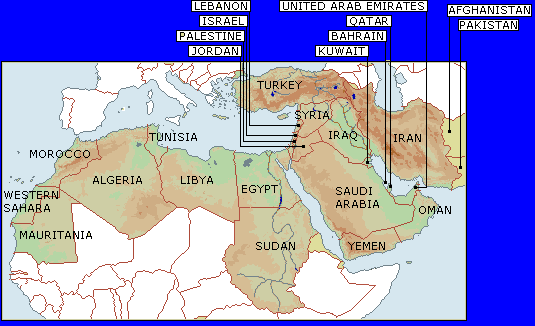
After the Islamic revolution in Iran in 1979, the West nervously waited for similar uprisings in the "Arab Street." Practically nothing changed in the Arab world in the last 30 years. In 2011regimes in Tunisia and Egypt have been overthrown by the peoples' demonstrations; the uprising in Libya has forced the international community to take military action against  Gadhafi; Yemen is witnessing bloody chaos; Syria is showing signs of serious unrest and Saudi Arabia intervened in Bahrain to crush the opposition.


         So far, none of the peoples' movements have been directed against the West. It was not "Western imperialism" but a combination of domestic political repression, youth unemployment, heightened expectations and socio-economic deprivation that mobilized Arab masses.Unfortunately, this positive dynamic may soon come to an end.In the eyes of many Arabs in the region, a deeply troubling Western double standard is emerging. Why is the West willing to intervene in Libya, while there is total Western silence about the brutal suppression of dissidents in Bahrain?
The West appears to be quite selective in lending its support to the "Arab Spring." The lesson that many are drawing is that two distinct standards apply to Arab citizens' rights. In countries like Libya, Egypt and Tunisia, the world will accept or actively support constitutional changes that citizens of those countries demand. In other Arab countries, like Bahrain, the rights of citizens are secondary to wider energy and security needs."
The fact that Saudi Arabia and the United Arab Emirates sent troops to Bahrain clearly shows that these energy-producing conservative Arab countries are deeply worried about a spillover of unrest into their own countries.
But such Western security concerns don't change the question that millions of Arab youth are asking: Why should the U.N. principle of "responsibility to protect" apply only to countries like Libya and leave Bahrain and Yemen out in the cold? Surely all regimes in the region are not equally brutal. Bahrain, Saudi Arabia or Yemen may appear to have more legitimacy than Gadhafi's regime in Libya, yet the Yemeni and Bahraini governments have shown no mercy against protesters. The double standard is also obvious in the Saudi behavior. The Saudis have backed intervention in Libya to help the rebels at the same moment as they have sent troops into Bahrain to help suppress a rebellion.

Unless Europe and the United States become more consistent in their support for democracy in the region, soon it will be radical Islamists and enemies of the West that will have the upper hand in mass demonstrations. But in the case of India, as we can expect India will shy away from taking position either side. At the end of the day India is never been in this process & it never will !!

Wednesday, 24 November 2010

Hard questions against the hardcore muslim fanatics !!

Though i had a innumerable Muslim friends since my childhood, i had an intriguing question swamping underneath my heart.. ie) why most religious problems are associated with Islam... I found that this religion was intolerable to the outsiders & inhospitable to other religion. Afghanistan brought down thousands of years old Buddha statue which was not built by destroying any pre-existing structure. I doubt if anyone in the muslim world raised any voice condemning it. When in India, the Babri masid which was built after destroying a pre-existing structure, so much hue and cry was made.ll countries with major Islamic population are going fanatic. See Turkey, Mustafa Kemal Ataturk's country, who looked west for its secularism, today under Recep Erdogan rule became Islamic fanatic. They want their women to wear veil whereas the men themselves wear tie and suit:) Let them wear cubba too like Komeyni.

Islam is the most respected but most ridiculous concept. I will be called a lunatic if I tell people that all people wearing brown shoes on Saturday should unite for destroying people who were black shoes on Monday. But if someone declares that all people who pray 5 times to an imaginary master should open fire against people who believe in another imaginary master, you call him a religious leader. And to add a side note : I call their followers stupid. You cannot be intelligent and religious. You can be religious only when you have less than standard IQ of a human being. The form that islam is developing into, its going to be no less than the Nazis and every non-muslim community has to save itself from them

Fine example of how to curb terrorism: 

            whenever the Hezbollah terrorists kill one or two Israel soldiers, the next day Israel will launch a full scale counter attack on them. That is the kind of aggressiveness a country needs, if it wants the patriotism and toughness to stay alive in every heart of the citizen. Today those Hezbollah terrorists would think twice before planning any attack on Israel, because they are frightened to death....

Wednesday, 10 November 2010

monarchisation of Indian democracy


India is a land of elections. Before it used to be farmers but also the country changes the rules of creation, this principle go via India to become the country's elections are the country's leaders sat. Do not know about that word choice, for their information are told that two words including word choice is made, choose and boat. Election process under the public picks a leader Rupie boat to get across the Styx to develop public.
Elections in India's history goes back. Well everything old is only the history but the history of elections need more than old. Before the kings and emperors ruled the country at that time elections were. King and Emperor of people as the future ruler of his sons were put to choose. For example, King Dashrath had chosen his eldest son Shri Ram so they can sit on the throne.
By kings and emperors of the people in the electoral process that was not a roll. When India gets independence from British raj in 1947, the new dawn begins in electing leaders too. Country since independence, culminating in the public a chance to participate in the electoral process, begun to. Leaders and the public, both were free. People enjoyed the freedom to vote and vote for the leader to take. Vote transaction is to choose the name of the same process that the status of democracy to Mentoen helps.
New face of Indian democracy is hypocrisy :


Would change this fact to prove the 1950s began with a political program that was established over time as cultural programs.
By the mid seventies were the elections in India every five years. These were the days when people were seen waiting impatiently for elections. After waiting impatiently to the public philosophy of the election were sorely. At intervals of five years when the elections were over the public tended to be unhappy. As - As time passed, the public felt the pain of the miserable living leaders election only once in five years was in the interest of the country nor in the public interest. By vote only once in five years that miserable pleasure to give the public the same way that increased the frequency of elections.
The result of such thinking leaders that the leaders began making plans to topple the government by stopping without elections - would be password. As a result the public not only states but also in the center was the vision of fallen governments.
Until the nineties people used their votes to choose only leaders so they can be made ruler. Until thenOnly governments and leaders to make sport of choice and played for was the spoiler. Busy people to vote and to hear the speech of that awareness did not come in their ability to vote with them with tax and its increasing ability to bear price rise hit the makers of TV serials was the look. The result was that these people public Indian Idol, Star Voice of India and give little weight to put the choice of masters.
The "SO" leaders people money to get the vote of the people, wine and bar. Those same people make such a program the voting forced by money. By vote to spend public money to be happy and engaged.


Some election experts believe that history repeats himself, while the value of the principle of the Documentary of the election process is now complete. Experts say that means that today's leaders have become like old time kings and their sons - daughters take to appoint his successor. It is opposed to the idea that the leaders son of experts - to win the public vote would have to daughters, so today's leaders as kings and emperors of ancient times believed democracy has taken a new dimension.
Indian elections, the country now - quite recognizable abroad - has been received. Democracy and political experts believe some native to the country's strength should be elections. Recently a few seasons - the scribes the heat, rain, and with a cold - with the election season is accepted as a new season. TV news channel war and struggle by those elections is accepted as synonyms. Battleground polls by some news channels have started to say. Given the popularity polls and increasing the country's largest business houses by market "election experts" to make the SEZ is proposed to open.
Overall can be said that the Indian election is the world's best choice Because in the name of democracy monarchy was set upped in each and every state, I am serving the best for last . Alas!!!! how i forgot 10 janpath, because it is the place where all gets started in "NAV BHARATH"

Wednesday, 13 October 2010

An unbiased outlook on Kashmi crisis


In 1948, the United Nations created a resolution for the warring nations of India and Pakistan over the area of Kashmir that allowed for the people of Kashmir to join either nation. Pursuant to the resolution, the two nations were instructed to hold a vote in Kashmir but it was never carried out. As a result, the area was divided and ruled separately, harsh conflict has continued ever since.
            This dispute is symbolic of the “age old” Indo-Pakistani antagonism that has been pursued for centuries. The following positions hold sway still to this day: India wants to maintain the current Line of Control as border line; Pakistan refuses to acknowledge Indian jurisdiction in the area, and neither nation will accept total independence for Kashmir. Of course there is the argument that this dispute is just another battle in the secular war between Muslims and Hindus, but over time the issues has become much more political that religious.
For India, the Line of Control is an abomination, as they understand it, they are entitled to the whole of Kashmir. However, over time they have ceded to the compromise of accepting the Line of Control as an international boundary line but they refuse to give up even one more acre. One of their main concerns is that granting Kashmir any further autonomy would create a movement in other Indian controlled territories.
            For Pakistan, the Kashmir territory is a symbol of their national ethnicity and as such they feel compelled to protect Muslim interests against Hindu (Indian) aggression and attempted control. As Kashmir does have a majority of Muslims in its population, it is an extremely attractive territory for Pakistan. In summary, Kashmir itself is a symbol of the struggle for land, power and identity for the Muslims and Hindus of the Pakistan and India.
            The dispute over Kashmir has caused both governments of India and Pakistan to spend incredible amounts of money and resources to support their forces in the area.  Jammu and Kashmir is the area of the most extreme religious-based terrorism. Kashmiri militants have abuses including, “deliberate targeting of Kashmir Hindus by fundametalists, terrorists groups and foreign mercenaries.” (GlobalSecurity.org) In 2003, India and Pakistan began taking steps to ease the tensions in Kashmir by restoring roadways, railways and air links, and also observed a ceasefire along the Line of Control.
During 2004, the violence in the region slowed and both sides of the Line of Control continued their communication over the dispute although neither nation changed their respective positions on the matter. “In early 2005 India and Pakistan launched a landmark bus service across the Line of Control in Jammu and Kashmir, allowing families divided by the Line of Control to be reunited for the first time in nearly 60 years.”  After the earthquake in October of 2005, tensions between Pakistan and India slowed to accommodate the great number of displaced peoples and allow for the free movement of humanitarian aid among the region and to remote areas.
            In 2006, the President of Pakistan created a series of alternatives to the Kashmir dispute. He proposed the idea of a self-governance system for Kashmir. The Indian Foreign Ministry countered the President’s offer by stating that they would agree under the condition that the borders were rendered irrelevant. In 2009, after sixty long years of dispute over Kashmir, India still fails to completely control the area. One of the most significant reasons for this failure is due to Pakistan’s creation of an exclusivist Muslim identity that at one time did not exist in the region and now coupled with India’s own failures in their administration of the area—there is still extreme conflict in the area.
Here we are in the year 2010 and the crisis is more than critical. Even the United States has its stake in the outcome of this dispute. “Obama, who alarmed the Indian government last year by telling an interviewer that he might push for a special envoy to Kashmir…but this anger is unlikely to last. What will remain, however, is India’s resistance to international intervention in Kashmir.” “Stone-pelters”, a now common term for the rioters in Kashmir are regular figures in the cycle of demonstrations against Indian rule. “An incident sparks a surge in demonstrations. There are injuries and finally and teenager is killed, hit by a teargas canister or shot. The demonstrations turn to riots, then repression brings a fragile calm. Until another cycle starts.” There are now more than 80,000 people dead in addition to the everyday routine of arrests, curfews, raids and checkpoints enforced by the Indian military in response to Pakistani militant groups. Roughly one million troops have been amassed on both sides of the Line of Control in Kashmir, which lately has prompted international concerns of a nuclear war.

As for the international community, “India is a counterweight, at least in the fantasies of western strategists, to China.”  Obviously the United States especially is anxious for Pakistan and India to come to a resolution largely in part because it would allow for Pakistan to give more focus to the militancy along its shared border with Afghanistan. The settlement of the Kashmir crisis would indeed be a monumental milestone in the international community marking a great peace between two of the most contested nations.

Tuesday, 7 September 2010

Palladian evaluation of India's past and future

India , The name itself portrays its elegance and unique history like none other country . This nation is always a center of attraction for more than a two millennium. Through out the history one can easily found that India is the most sought country than any other. So well what seems to be intriguing fact is that “From a country which was thought as heaven around the world”, therefore they desperately need to have a relationship at any cost ie..spice trade, technology, education etc… But soon it elegance and charisma becomes the villain for its own cause… For the last 700 years till 1947 slowly the colour of her charisma and the perceptions tilted from desirable nation to exploited. From then on until 1990’s India was considered as an obnoxious overpopulated poor country with an approx GDP of around 3%. Nepotism, favoritism, corruption, bureaucracy grew with leaps and bounds. Dynasty politics overtook the democracy which is claimed to be!!!

Degaged growth:

     From 1990’s onwards inevitable reforms are imposed on her, GDP gained momentum from lukewarm to spectacular, at the same time problems are also increases virtually. Today India considered as a cheap labour state where MNC'S can suck their effort with low cost, What a transmission from a golden state to most ugliest state. Terrorism, weak leadership, opportunism, misplaced loyalty are the order of the day which are indeed the derivated products which India reaps..  According to nominal GDP Bharat is 11th economy in the world. If Purchasing power parity is taken into account, India's economy is 4th  in the world at US$3.561 trillion. From the above stats shows India is growing in a rapid pace which ultimately lead her in to a superpower. From missile tech to rocket we achieved which only a handful of countries done it before. But the HARD fact is divide between the rich and the poor increases ever than before which are irreversible. Corresponding to a per capita income, the country ranks 139th in nominal GDP per capita and 128th in GDP per capita at PPP. This shows the irreplenishable gap between the two.

Need of the hour:

     GOI should address the people’s grievances rigorously because frustration and inability are the strong cause for violence, Maoism etc.. Corruption should be monitored and kept under the control because bribery is a common phenomena which unifies this country eg, PWD, traffic control get corrupted from Jammu to cape comorin .  PM should be a leader rather than a right wing puppet economist. No leader shouldn’t given a chance to contest an election or post more than twice which provides opportunity to all. Desperately our trade & foreign policy should be revamped… Position on Tibet-Thalailama issue should be negated because it gonna lead us anywhere but china’s strategic help is very important. Well in Pakistan issue , we should follow the  paradigm of South korea and North Korea because relationship or trust cannot be erected with long term foes at least for short term. For other countries , India’s national interest should be the top priority therefore other countries vested interested on India can be nullified.

Finally the Gov should took war effort to save agriculture, because are moving away from unprofitable agri business to the other which is potentially disastrous. NREGS is not the only solution for Employment menace. More over India needs a vision not only in paper but also in reality. we need a leader likes Lee Kuan Yew Lee who can see the “country as a home not home as a country”


Friday, 20 August 2010

Legacy of corruption

  At the time INDIA is waiting for a apt time to announce its arrival as a super power, at the time CONGRESS is announced as one of the richest political party in the world, at the same time India is announced as a place where this great nation has more poor and pitiable people than in AFRICA. What a shame when our country's GDP is approaching 9% . At the same time rollicking corruption charges were made against CWG committee which is supposed to be a flagship event for INDIA to showcase her power. No wonder in our country no high grade corrupt babus are punished. The legacy of corruption is the only one major phenomena where it cut it across all party lines from Congress to RJD, DMK to BSP. From  J&K to TN integrity is seen only is bribery and corruption.

Corruption in India is a consequence of the nexus between Bureaucracy, politics and criminals. India is now no longer considered a soft state. It has now become a consideration state where everything can be had for a consideration. Today, the number of ministers with an honest image can be counted on fingers. At one time, bribe was paid for getting wrong things done but now bribe is paid for getting right things done at right time. Our democracy is itself based on corruption and nepotism. This is not the democracy we longing for!!!!!!!

  Indian administration is tainted with scandals. India is among 55 of the 106 countries where corruption is rampant, according to the Corruption Perception Index 2004 Report released by Transparency International India. Corruption in India leads to promotion not prison. It is very difficult to catch big sharks. Corruption in India has wings not wheels. As nation grows, the corrupt also grow to invent new methods of cheating the government and public.


Corruption is a global problem that all countries of the world have to confront, solutions, however, can only be home grown. We have tolerated corruption for so long. The time has now come to root it out from its roots. We need people like  P.SAINATH to take the initiative and up the ante.